


Deciding how to handle freight operations is a pretty big deal for any business. Whether you’re shipping all the time or just during certain seasons, the way you move your goods affects your costs, delivery speed, service quality, and how much time your team spends on logistics headaches. Most companies end up choosing between working with a freight broker or building their own in-house freight management team.
The main difference? Freight brokerage means you outsource carrier sourcing and load execution to someone else, while in-house freight management keeps all the logistics planning, carrier relationships, and shipment oversight under your own roof. Both approaches have their perks, depending on how much you ship, your budget, the expertise you’ve got, and your long-term supply chain plans. Knowing these differences definitely helps you pick a freight strategy that fits your business and what your team can handle.
At Travero Logistics, we talk with businesses wrestling with this choice all the time. Our team supports shippers with freight brokerage, warehousing, rail and barge services, transloading, and custom multimodal solutions that actually fit your challenges. Whether you’re thinking about outsourcing or trying to figure out if you should manage freight yourself, we’re ready to help you sort it out. Reach out to our logistics pros if you want to chat or get a quote.
Core differences between freight brokerage and in house freight management
Freight brokerage and in-house freight management are two pretty different ways to move goods, with their own structures, resource needs, and levels of control. When you see how these models play out in daily operations, it’s easier to decide what works for your logistics.
Definitions and roles
A freight broker acts as the go-between who connects shippers and carriers. They don’t own trucks or touch your goods. Instead, they tap into their carrier networks, negotiate rates, and set up shipments for clients.
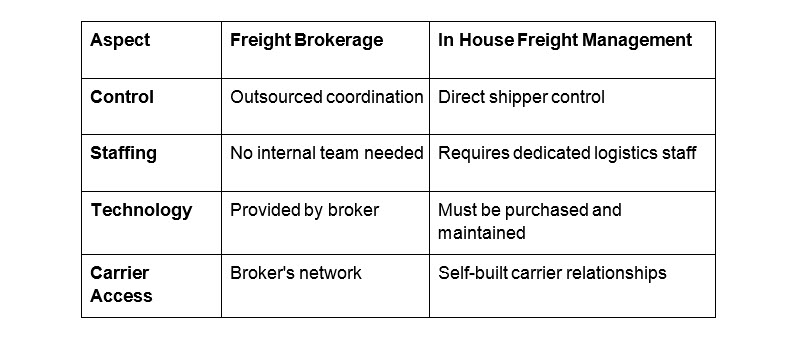
With in-house freight management, your company builds its own logistics department. Your team handles carrier relationships, shipping coordination, freight auditing, and supply chain oversight, usually using your own systems. You keep direct control over every part of the transportation process.
Freight forwarders actually take legal responsibility for shipments and often consolidate freight from different shippers. We help businesses figure out whether outsourcing or building internal capabilities makes more sense, depending on shipment volume, complexity, and resources.
How each model operates
Freight brokers work on a transactional or contract basis. When you need to move something, the broker taps their carrier network, books the shipment, deals with paperwork, and tracks the load until it’s delivered. Brokers usually work with lots of carriers across different modes and handle the logistics tasks you’d rather not deal with.
In-house freight management means you hire people who build direct carrier relationships, negotiate rates, manage your transportation system, and handle claims and auditing. You get full visibility and control, but you’ve got to invest in staff, tech, and constant carrier vetting. Companies that ship a lot usually see value here because they can optimize routes and use their buying power.
Key stakeholders involved
In freight brokerage, you’ve got three main players: the shipper (that’s you), the broker, and the carrier. The broker manages the relationships and keeps everyone in the loop from pickup to delivery. We handle coordination with all parties to keep things running smoothly.
In-house freight management puts your logistics team in direct contact with carriers. You cut out the middleman, but your staff has to source capacity, negotiate rates, track shipments, and solve problems. Sometimes you’ll also work with tech vendors for your transportation system or third-party auditors for freight bills.
Companies with facilities like our Logistics Park Cedar Rapids and Logistics Park Dubuque sometimes use a hybrid approach, mixing in-house management with brokerage for overflow or special lanes.
Benefits and limitations of freight brokerage
Freight brokerage brings advantages in cost management and carrier access, but it’s not all upside. There are trade-offs in visibility and customs coordination. Knowing where brokerage shines (and where it doesn’t) helps you figure out if it fits your shipping needs.
Cost savings and flexibility
Freight brokers help you save money by working with lots of carriers and negotiating good rates on each shipment. This setup works great for businesses with unpredictable shipping patterns or seasonal spikes.
You don’t have to sign long-term contracts or commit to minimum volumes with brokers. Just book capacity when you need it, no need to keep a transportation team or resources on standby.
Key cost advantages:
- No money spent on infrastructure.
- Access to spot market rates when things are slow.
- Lower overhead since you’re not managing carrier relationships yourself.
- Easy to scale shipping volume up or down.
But watch out, spot rates can jump during busy seasons or when trucks get scarce. If you’re shipping high volumes on the same routes, you might end up paying more than if you negotiated directly with carriers.
Carrier network and capacity access
Freight brokers keep big networks of vetted carriers, so you get fast access to trucks and different equipment types. This diversity really matters when your regular carriers are booked or you need something specialized.
Brokers take care of vetting, insurance checks, and keeping tabs on performance. We see that this makes a difference, especially when capacity is tight and trucks are hard to find.
The flip side is, you don’t always get to pick your carrier. Brokers assign loads based on availability, so the relationship is a bit hands-off. Service quality can vary between carriers in the broker’s network.
If you need a specific service level or specialized handling, this lack of control can create operational challenges.
Documentation and customs coordination
Freight brokers handle the paperwork, bills of lading, proof of delivery, and freight bills, which takes a load off your team and keeps you compliant for domestic shipping.
Most brokers don’t handle customs clearance for international freight. Customs brokers take care of tariffs, duties, and filings, and that’s usually outside a broker’s wheelhouse.
If you’re shipping cross-border, you’ll need to work with a customs broker or a freight forwarder who can handle customs. That adds more coordination and, honestly, more chances for miscommunication.
Businesses at places like Logistics Park Cedar Rapids or Logistics Park Dubuque moving international goods through inland ports really need partners who can bridge domestic transportation and customs.
Real-time visibility and tracking
Most brokers offer basic shipment tracking, pickup, in-transit updates, and delivery confirmation. This info depends on carrier check-ins, so you don’t always get a live feed.
How much real-time visibility you get really depends on the broker’s tech and how well they connect with carriers. Some have decent tracking platforms, others just call or email updates.
Typical tracking limitations:
- Status updates can lag between carrier check-ins.
- Exception management and alerts are pretty limited.
- No integration with your transportation management system.
- Not much in the way of analytics or reporting.
If you need detailed supply chain visibility or want your systems to talk to each other automatically, standard brokerage tracking probably won’t cut it. Companies shipping time-sensitive goods or running just-in-time inventory usually need more than what basic brokerage offers.
Advantages and challenges of in house freight management
In-house freight management gives you direct control over shipping, but it comes with big investments in people, tech, and infrastructure. Deciding to handle logistics yourself means weighing the benefits against the resources you’ll need and whether you can scale long-term.
Control and customization
When you manage freight in-house, you call the shots on carrier selection, routes, and delivery schedules. Your team makes decisions based on your own operations, not someone else’s priorities.
You also get real-time visibility across your supply chain. You can set up tracking systems that fit your needs and tweak processes on the fly when problems pop up. Talking directly to carriers cuts out the go-between and speeds up issue resolution.
Customization is way easier when you run logistics yourself. You can build workflows that actually fit your production schedules, inventory, and customer delivery requirements. If you import or export special cargo, you can set up compliance and handling protocols that match your needs.
Integration with business operations
With in-house freight management, your logistics data connects straight to your business systems. Accounting, inventory, and customer service platforms all pull from the same info, no need to sync with a third party.
This kind of integration makes supply chain management smoother by giving everyone the same shipping data. Your warehouse, sales, and logistics teams can avoid crossed wires and forecast more accurately. Order processing speeds up since your teams coordinate pickups and deliveries based on what’s actually ready.
You also get tighter control over insurance and liability. Your team handles all the paperwork, compliance, and claims using your own rules. That cuts down on miscommunication that can happen when outsiders manage these details.
Expertise and resource demands
Building an in-house freight team means hiring logistics pros who know carrier networks, rate negotiations, and compliance. Recruiting and keeping good staff adds ongoing costs.
You’ll need to invest in technology to keep up with third-party providers, transportation management systems, tracking, and analytics. These systems need regular updates, maintenance, and training.
Insurance, facility needs for logistics operations, and staying current with industry changes all add to your resource load. Smaller businesses often have a tough time justifying the expense unless they ship enough volume to get economies of scale.
Scalability for shipping volume
In-house freight management works best when your shipping volume is steady and predictable. Consistent demand lets you right-size your team, carrier contracts, and systems for efficiency.
But if your volume swings, it’s tough. Seasonal peaks mean hiring temps or paying overtime, while slow times leave people and resources idle. Sudden growth can overwhelm your team and systems.
Businesses shipping multiple loads every day often make in-house management cost-effective once they’ve made the initial investments. But if your shipping is irregular, it’s hard to stay efficient. You lose flexibility if your team can’t match the carrier network or capacity options that brokers or big logistics partners offer.
Strategic considerations for choosing the best approach
Choosing between freight brokerage and in-house freight management really comes down to your costs, how much control you want, and your company’s specific logistics needs. The best fit depends on looking at total expenses, how each model impacts your supply chain, and what works for your industry and business size.
Cost-benefit analysis
Total cost of ownership isn’t just about transaction fees. In-house freight management means paying staff salaries, training, investing in transportation management systems, and constantly building carrier relationships. These fixed costs can run from $150,000 to $500,000 a year for mid-sized operations before you even ship anything.
Freight brokerage usually comes as a variable cost tied to how much you ship. Broker margins average 15-20% of freight costs, but that covers negotiated carrier rates, claims management, and round-the-clock support. For companies shipping fewer than 100 loads a month, brokerage often ends up cheaper.
We’ve seen businesses cut admin overhead by 30-40% after switching from in-house to brokerage. But if you’re moving 500+ loads a month, you might get better rates with your own team. Where the break-even point lands depends on shipment frequency, lane complexity, and whether you can leverage shipping volume for carrier discounts that keep up with or beat what brokers can negotiate.
Impact on supply chain management
Control over the transportation process really shifts depending on the model. When you manage things in-house, you get to talk directly with carriers, make snap decisions, and tweak solutions to fit weird or unique logistics problems. That kind of hands-on approach can be crucial if you're dealing with tricky shipments, tight schedules, or need to line things up perfectly with manufacturing.
Freight brokers, on the other hand, bring a huge carrier network and a lot of know-how to the table. We keep up with thousands of vetted carriers across all kinds of transportation modes, so finding capacity during busy seasons or when the market's tight is a lot quicker. Thanks to this network, we see shipping delays drop by about 18% compared to teams that stick with just their own carrier lists.
Visibility and reporting? That really depends on who you work with. Some brokers have stepped up their game, offering real-time tracking, exception management, and analytics dashboards that can go toe-to-toe with the best in-house setups.
Companies tapping into freight brokerage services get a shot at more supply chain flexibility, all without having to build out complicated internal systems. Logistics teams can finally spend more time on strategy instead of getting bogged down in the daily grind.